
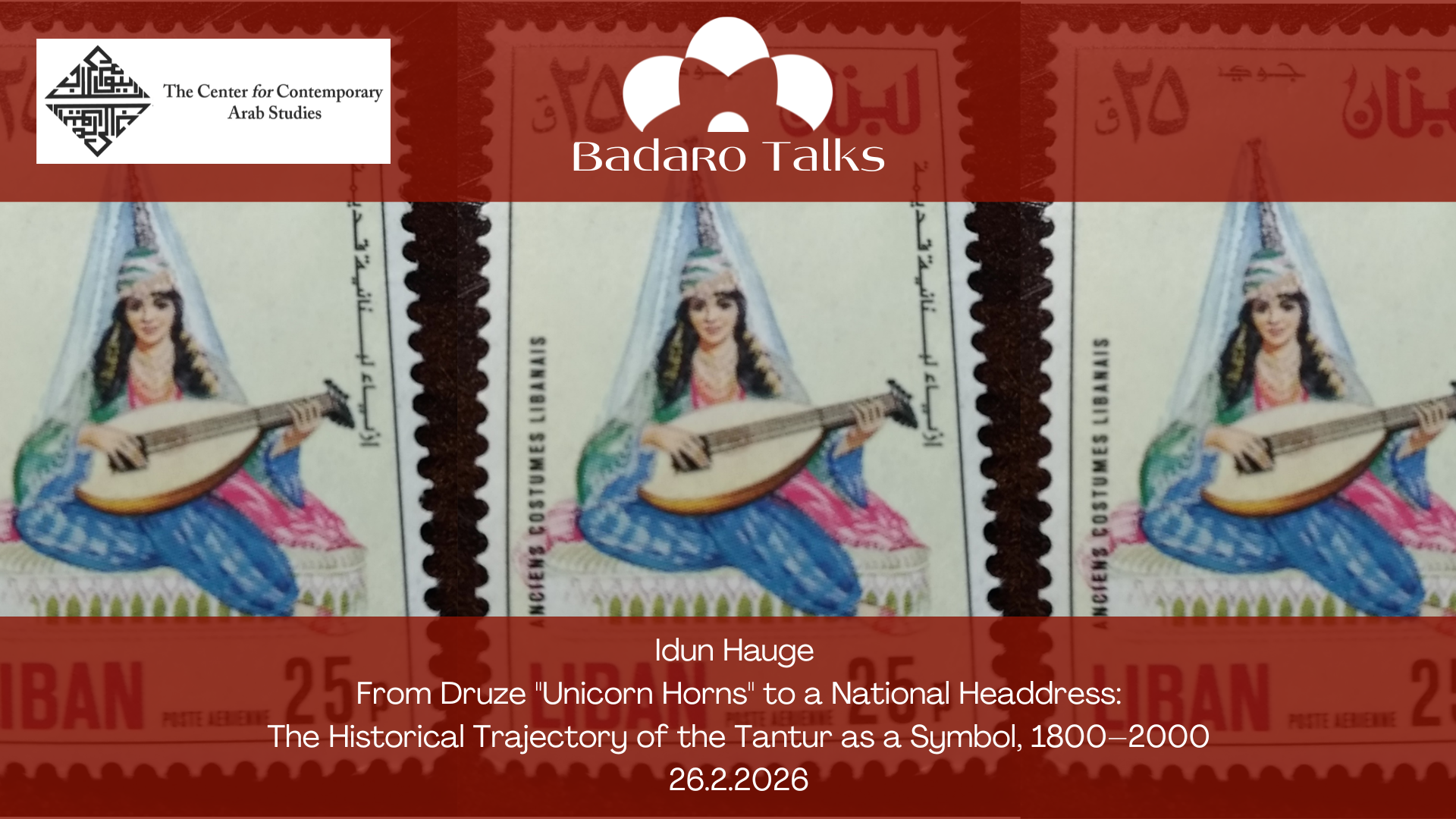
From Druze ”Unicorn Horns” to a National Headdress: The Historical Trajectory of the Tantur as a Symbol, 1800–2000
 30 Badaro Street, Chaoui Building, 5th floor meeting room
 26.2.2026
 19:00 – 21:00
Please join us for the Badaro Talks, presented by historian of the modern Middle East, Idun Hauge. The lecture is co-organized with the Georgetown University Center for Contemporary Arab Studies. The lecture explores how the Lebanese tantur headdress evolved from a marker of women’s social status in Mount Lebanon into a powerful symbol shaped by Orientalist narratives and later Lebanese nationalism.
When: Thursday 26th of February at 7pm (please note the time).
Where: The FIME premises at 30 Badaro Street, Chaoui Building, 5th floor meeting room, or Zoom.
We kindly request you to RSVP through this link or by sending an email to institute@fime.fi at the latest on Wednesday 25th of February.
To attend online, you also need to register.
Abstract
The tantur was a headdress imbued with social meaning and worn by Druze and Maronite women of Mount Lebanon to communicate their marital and social status until the mid-nineteenth century. Simultaneously to the headdress dying a slow social death from the mid-1840s onwards, when only Druze women wore the tantur, Orientalist travelers and photographers revived the headdress as the visual marker of Druze cultural authenticity. Beyond its exoticization as a “unicorn horn,” European travelers described it as a “torment” and a symbol of the perceived excessive misogyny of the “Orient.” Drawing on this tradition of colonial knowledge-production, Lebanese nationalists largely accepted Orientalist travelers’ accounts and revived the headdress as a symbol yet again, but within a domestic ideological context.
In the mid-twentieth century, Lebanese nationalists elevated the tantur as a nationalist symbol that served as proof of Lebanon’s distinct cultural identity. The tantur emerged in folkloric events, the tourism industry, and newspaper debates as a symbol of the shared culture of Maronite and Druze communities of Mount Lebanon. This formed part of a larger process of centering Mount Lebanon as the only authentic source of Lebanese culture and rejecting Lebanon’s Arab and Islamic heritage. As the tantur became divorced from its original social meaning first by Orientalist travelers and then by Lebanese nationalists, this lecture traces the rhetorical process of turning the tantur into specific symbols imbued with ideology and power relations during the nineteenth and twentieth centuries.