
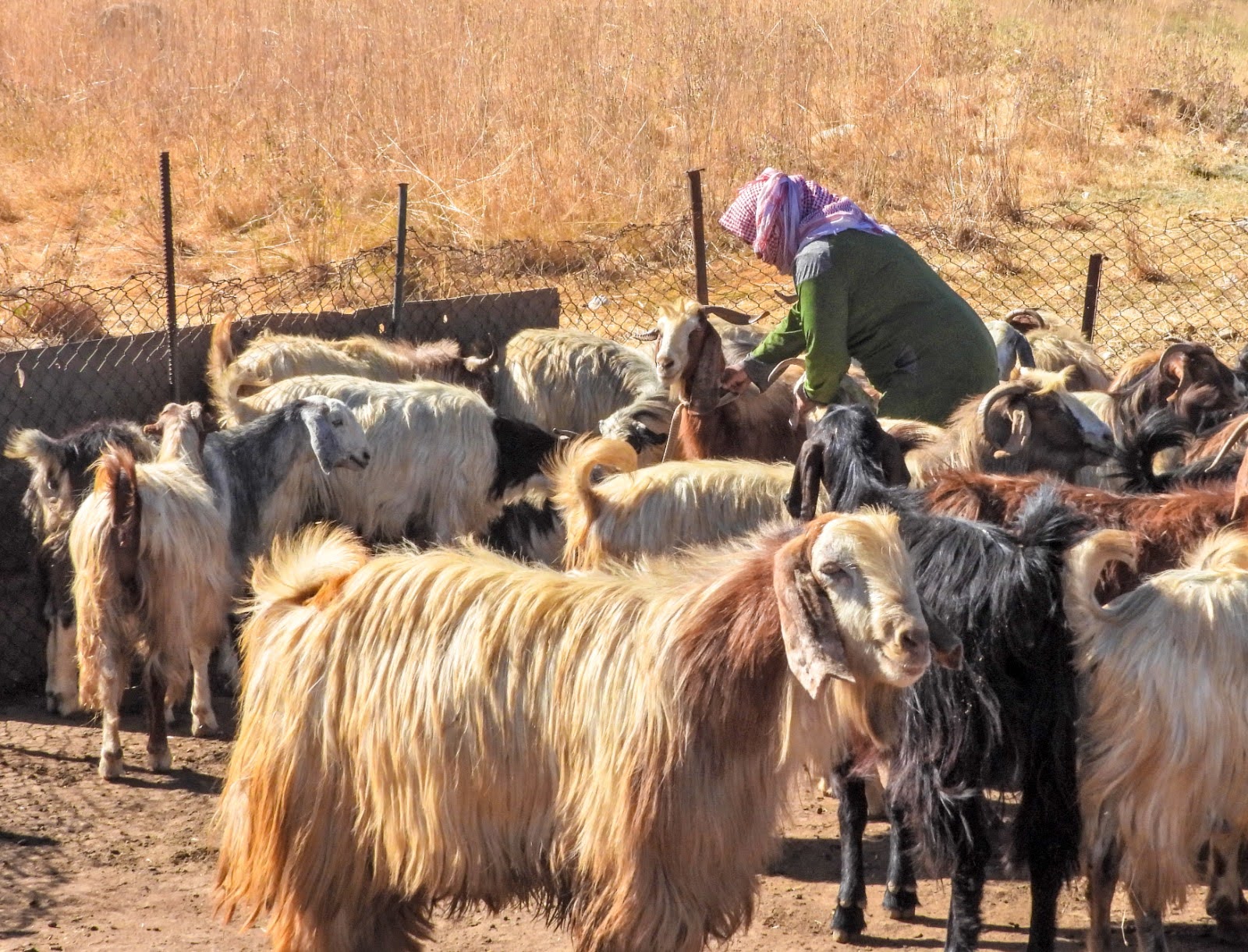
Badaro Talk: Adaptive Communities, Complex Governance: Pastoralism at the Crossroads of Ecology and Rural Politics
 4th floor, Omnipharma Bldg B, Badaro, Beirut
 11.12.2025
 18:00 – 20:00
Please join us on for the next Badaro Talks, presented by the PhD candidate Moustapha Itani. The lecture delves into rural Lebanon. It examines how local power dynamics shape grazing practices and vegetation patterns, often in ways that challenge common assumptions about rural sectarianism or environmental degradation.
You can also attend online by registering for the event.
RSVP: We kindly request you to RSVP through this link or by sending an email to institute@fime.fi at the latest on Wednesday 10th of December.
Abstract
Rural Lebanon is often simplified in media and academic narratives. This talk examines how pastoral communities negotiate ecological variability, economic hardship, and shifting political structures. Drawing on fieldwork in a Key Biodiversity Area spanning the highlands of Sannine southwards through Chouf to Rihane, I mapped and analyzed pastoral governance systems, revealing a surprisingly diverse mosaic.
Some systems, such as hierarchical clan-mediated arrangements (daman/samsar) and private rental regimes, have adapted to the state’s administrative presence, complementing it at times with the de facto authority of clans. Others, like residence-linked sovereign commons (rabh’hum), may operate in tension with municipalities and local authorities. Contrary to dominant urban narratives about sectarianism, sectarian land-use patterns in these highlands largely mirror residential geographies rather than explicit governance rules, pointing to a more intertwined rural socio-economic fabric.
Where local leadership and conservation actors have advanced pro-nature initiatives, outdated environmental policies, especially those that blame pastoralism for degradation, have disrupted transhumance and intensified competition over shrinking pastures. Landscape-scale analyses of governance types (encampment clumpiness, flock size, distance to municipal cores, stocking densities) reveal that governance hierarchies are not associated with losses in plant species richness, but rather with declines in vegetation quality. Time-series land-use data further show that clan-mediated systems which degrade vegetation quality may paradoxically slow land-use encroachment, providing informal protection of rangelands.
Taken together, these findings highlight the complexity of pastoral governance in Lebanon and point toward area-based solutions that serve both ecological integrity and community well-being.
Bio
Moustapha Itani is a PhD candidate in the Doctoral Programme in Interdisciplinary Environmental Sciences (DENVI) at the University of Helsinki. His research bridges socio-ecological systems, biodiversity conservation, and sustainability science, with a focus on pastoral governance systems and vegetation dynamics in Lebanon’s high-elevation rangelands. His first dissertation paper, Pastoral Governance Hierarchies Shape Vegetation Dynamics in Lebanon’s High-Elevation Rangelands, has recently been accepted in Agriculture, Ecosystems & Environment. Before joining DENVI, he worked for several years at the American University of Beirut’s Nature Conservation Center on plant-conservation projects, cultural-area vegetation management, and collaborative research in Mediterranean biosphere reserves.
Picture: Chadi Saad