
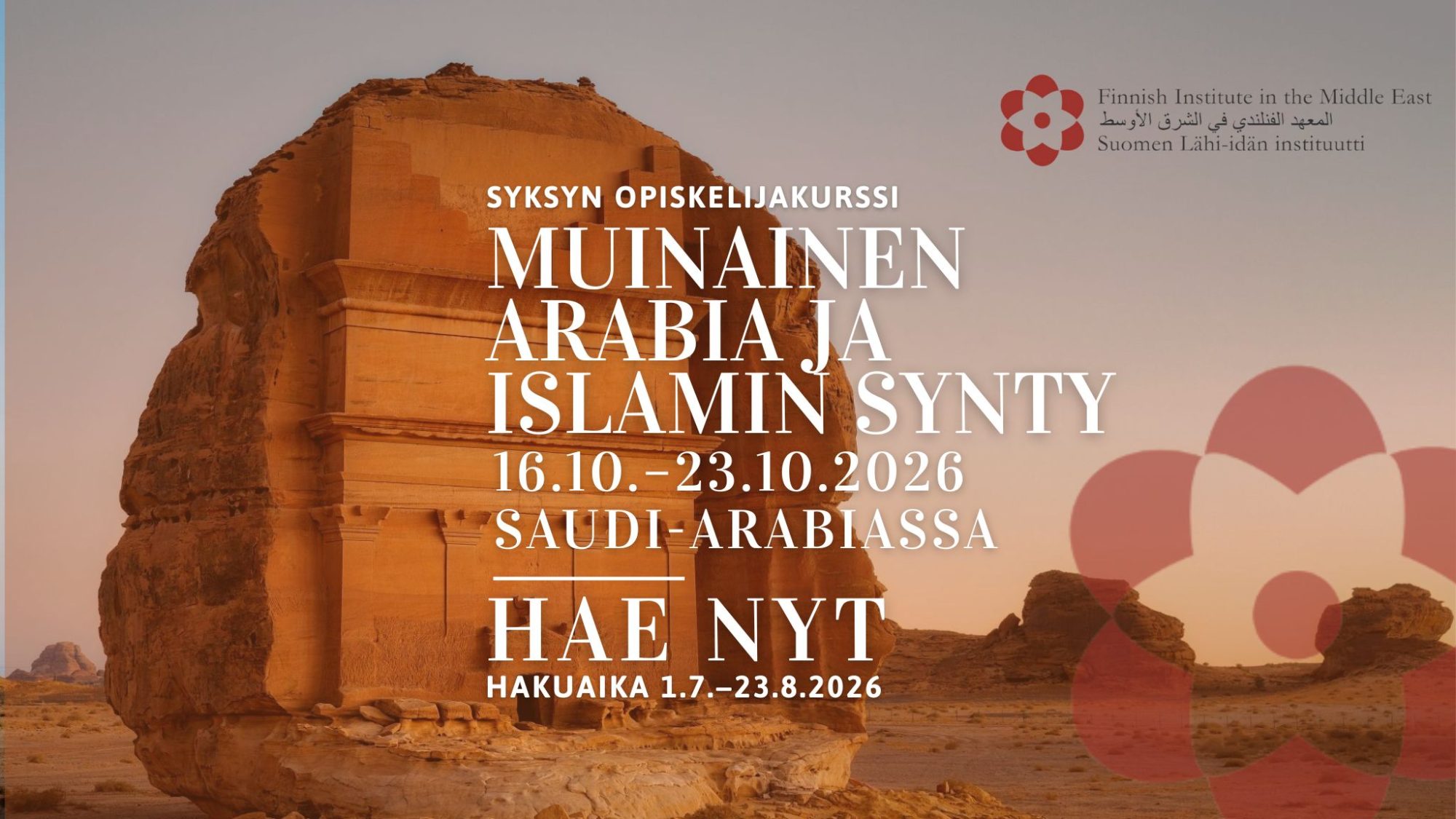

The Finnish Institute in the Middle East’s autumn student course, “Ancient Arabia and the Origins of Islam,” will be held in Saudi Arabia from 16–23 October 2026. The course explores the history of ancient and Late Antique Arabia, with a particular focus on the oasis towns of the Hijaz (western Arabia). Chronologically, the course covers the period from the reign of Nabonidus (556–539 BCE) to the earliest history of Islam (610–632 CE).
During the ancient period, the Nabataean Kingdom (ca. 300 BCE–106 CE) was a major political power whose territory extended into the Hijaz, reaching the vicinity of Medina (ancient Yathrib). Following the collapse of the Nabataean Kingdom, the Romans and later the Ethiopians periodically sought to control the important oasis towns of the Hijaz. In Late Antiquity, however, before the mission of the Prophet Muhammad, these towns functioned largely as independent city-states. The rise of Islam brought them together under a single polity. Many of the region’s oasis towns flourished during both the pre-Islamic and Islamic periods, although some settlements (such as the Nabataean city of Hegra) had already been abandoned before the emergence of Islam. Literacy was widespread on the Arabian Peninsula, and tens of thousands of inscriptions carved into stone have survived across the region.
The study trip examines both social and political history. Particular emphasis is placed on the material evidence discovered in the region (including inscriptions and archaeological remains), which participants will study on site. The course concludes with the emergence of Islam.
- Course dates: 16–23 October 2026, Saudi Arabia
- Application period: 1 July–23 August 2026. Applications must be submitted via this online application form.
- Credits: 5 ECTS (credit transfer must be arranged with the student’s home institution)
- Languages of instruction: Finnish and English
- Course instructor: Ilkka Lindstedt, University of Helsinki
- Eligibility: The course is open to 9–10 undergraduate and master’s students from Finland or enrolled at Finnish universities in relevant disciplines (e.g. Islamic studies, history, archaeology, anthropology, or theology).
- Course format: The course consists of online lectures held prior to the trip, the study trip itself, and related assignments. Further information regarding course requirements and credit transfer will be provided to students admitted to the course.
- Course fee: €650. The fee includes round-trip flights from Helsinki to Medina, accommodation, site visits, and transportation within Saudi Arabia. It does not include the visa fee or meals. Students admitted to the course are required to obtain travel insurance. Travel dates are 16 and 23 October. Please note when applying that the course fee must be paid by 14 September 2026. Admitted students are responsible for obtaining their own Saudi Arabian e-visa prior to departure (approximately €130). For the visa application, passports must be valid for at least six months after the end of the trip.
- Accessibility: Step-free access to all sites visited during the course cannot be guaranteed.
- Further information: Joanna Töyräänvuori, Researcher, Finnish Institute in the Middle East (joanna.toyraanvuori@fime.fi)